

Pilot Study
Community-led Conservation & Acoustic Monitoring in Action

Rukwa-Katavi Ecosystem, Tanzania

In partnership with Biometric.earth, villages bordering Katavi National Park, Luafi Game Reserve, and the Mpwimbwe Wildlife Management Area (WMA)

Funded by Elephant Crisis Fund

Wild Survivors partnered with Biometrio.earth to pilot an innovative acoustic and camera-based biodiversity monitoring program. Together, we set out to “hear” the landscape and reveal how wildlife moves through the Mpimbwe WMA, a vital corridor connecting Katavi National Park and Luafi Game Reserve.

Fostering Coexistence in Tanzania’s Rukwa–Katavi Landscape
In the heart of western Tanzania, where elephant paths trace through woodlands and riverine forests, communities are leading a quiet revolution in coexistence.
Launched in 2024, the Rukwa–Katavi Coexistence and Biodiversity Initiative empowers people to live alongside elephants through sustainable livelihoods and community-led conservation.
As part of this work, a pilot study with biometrio.earth introduced nature-based technology to track biodiversity using their IN-SITU STARTER system. Five pairs of wildlife cameras and acoustic recorders were placed in buffer zones used by elephants as they travel across the Rukwa–Katavi landscape.
Why Biodiversity Monitoring Matters
Stretching over 92,000 square km, the Rukwa–Katavi ecosystem remains one of East Africa’s last great wildernesses, vital for supporting the region’s largest elephant population.
Yet this richness faces growing threats. Intensified competition for space and crop losses from elephants strain livelihoods and heighten human–wildlife conflict. We work at the centre of these challenges, helping communities implement coexistence tools - like beehive fences - that deter elephants while creating income from honey and forest-friendly farming.
The biodiversity monitoring pilot added a new dimension: turning listening into conservation. By gathering data on species presence and habitat use, communities can make better land-use decisions, reduce conflict, and strengthen local stewardship.
what we heard
Eco-acoustic and Bio-acoustic Insights
For the pilot, five compact Wildlife Acoustics Song Meter Micro 2 recorders were deployed alongside Solaris camera traps in northern Mpwimbwe WMA, areas known for elephant movement between parks and community lands. Each device recorded up to 280 hours per deployment, weatherproof and reliable even in remote terrain.
Across 150 days, the recorders captured nearly 37,000 sound files. Analysis focused on two lenses: ecoacoustics, exploring the overall soundscape to detect habitat-level differences, and bio-acoustics, identifying individual species through their calls.
The results painted a vivid picture:
Grasslands and forests buzzed with diverse life, their calls spanning wide frequency ranges.
Shrublands were quieter, suggesting fewer species or unique community structures.
Even with just five monitoring sites, the patterns revealed distinct ecological communities within the WMA—vital knowledge for planning conservation priorities and identifying sensitive habitats.
The Power of Acoustic Monitoring
Traditional biodiversity surveys are costly and limited. Acoustic monitoring is a powerful alternative.

Non-intrusive
Digital microphones capture wildlife vocalisations day and night for months at a time without disturbing wildlife and the environment.

Scalable & Cost Effective
Digital microphones capture wildlife vocalisations day and night for months at a time without disturbing wildlife and the environment.

Versatile application
They can identify and analyse the sonic signatures of birds, mammals, frogs and even insects.

Insightful
These ecoacoustic methods reflect the full “soundscape” of the environment, be revealing patterns that portray habitat health.
Why Birds Matter
the voices of birds
Among the most compelling discoveries were the birds. Despite the pilot’s small scale, it detected nearly a third of all bird species previously recorded in the wider region—an extraordinary testament to the ecosystem’s richness.
Highlights included:
The Grey Plover, rarely seen inland and considered vulnerable.
The Gray-olive Greenbul, known for its limited range and distinctive call.
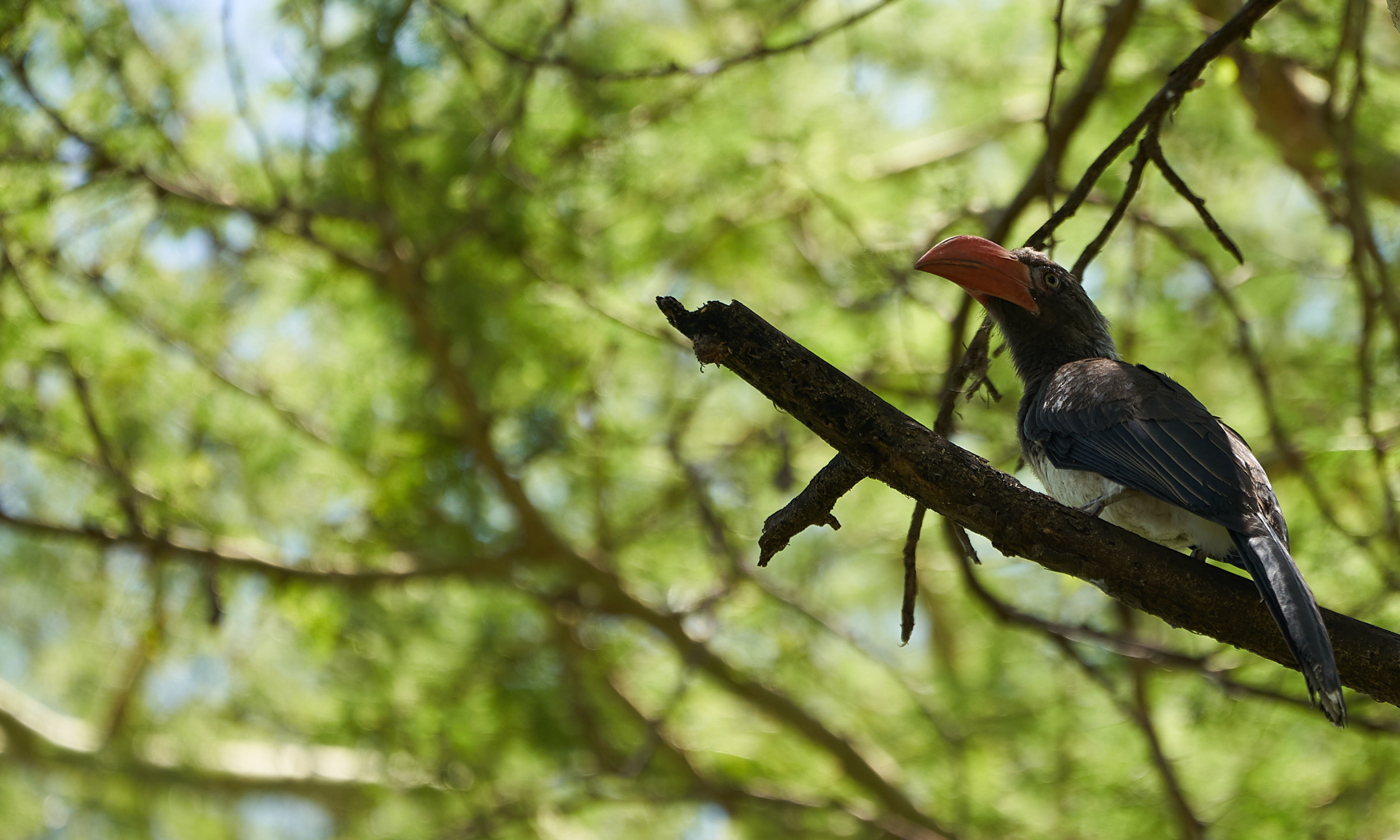
The Crowned Hornbill, Purple-crested Turaco, and Crested Barbet, colourful forest dwellers that play essential ecological roles. Hornbills, for instance, are forest architects, dispersing seeds that regenerate woodlands. Their presence signals resilience - proof that these forests still breathe with life.

Challenges and Lessons Learned
Like all pilots, this one faced limitations. With only five sites and four months of data, rarer or quieter species likely went undetected. Existing machine learning models also lack training data for many African bird species, meaning expert validation—part of biometrio.earth’s COMPLETE solution—was beyond the project’s scope.
Still, the findings are invaluable. They show how even small-scale monitoring can guide coexistence planning and inform broader conservation strategies.
Next Steps
The Mpwimbwe pilot proved that listening can be as powerful as seeing. Moving forward, the approach can grow in several ways:
Expand coverage: Place more recorders across diverse habitats and villages.
Monitor year-round: Capture the ebb and flow of seasonal biodiversity.
Refine AI models: Improve detection for rare and endemic species.
Engage communities: Share recordings and visualizations to inspire stewardship.
Create acoustic archives: Build a living library of soundscapes from under-studied tropical regions.
Each recording is more than data—it’s a heartbeat of the landscape. By listening to the forests and fields of Mpwimbwe, we uncover a richer story of coexistence, resilience, and renewal.